


Precipitation distribution characteristics of microbial mineralization sealing rock mass fractures on permeability
-
摘要: 地下水封油库对洞室渗水量有严格的要求,需进行注浆渗控。微生物诱导碳酸钙沉淀(MICP)生成的微生物水泥具有浆液颗粒小、黏度低、流动性好等优点,为封堵岩体微裂隙提供了新的思路。微生物矿化注浆封堵岩体裂隙降渗过程包含了微生物水解尿素、矿化沉淀反应以及沉淀在裂隙中附着和分布等一系列反应。本文首先阐述了微生物矿化反应基本原理,基于目前研究和应用最为广泛的脲酶水解尿素反应方式介绍其生物酶催化作用,然后通过分析脲酶水解尿素反应过程中生成的沉淀对裂隙隙宽的影响,推导了矿化反应沉淀在裂隙中不同的附着特征对裂隙渗透性降低的理论公式,同时相应地分析了影响效果。本文旨在通过了解微生物矿化封堵岩体裂隙降渗过程中耦合关系,为后续微生物矿化封堵岩体裂隙降渗机制研究提供理论基础。Abstract: Groundwater-sealed oil depots have stringent requirements for the water seepage of the chambers, necessitating grouting for seepage control. Microbial-induced calcium carbonate precipitation (MICP), which generates microbial cement, offers new ideas for sealing micro-fissures in rock masses due to its small slurry particles, low viscosity, and good fluidity. The process of reducing seepage through microbial mineralization grouting and sealing rock fissures involves a series of reactions such as microbial urease hydrolysis, mineralization reactions generating precipitation, and the attachment and distribution of precipitation in the fissures. This research first elaborates on the basic principles of microbial mineralization reactions, and introduces the biocatalytic effect based on the most widely studied and applied urease-catalyzed urea hydrolysis method. Then, by analyzing the impact of the precipitation generated during urease-catalyzed urea hydrolysis on the fissure width, theoretical formulas for the reduction of fissure permeability due to different attachment characteristics of mineralization reaction precipitates are derived, and the corresponding influencing effects are analyzed. This article aims to provide a theoretical basis for subsequent research on the mechanism of reducing seepage through microbial mineralization sealing of rock fissures by understanding the coupling relationships involved in the process.
-
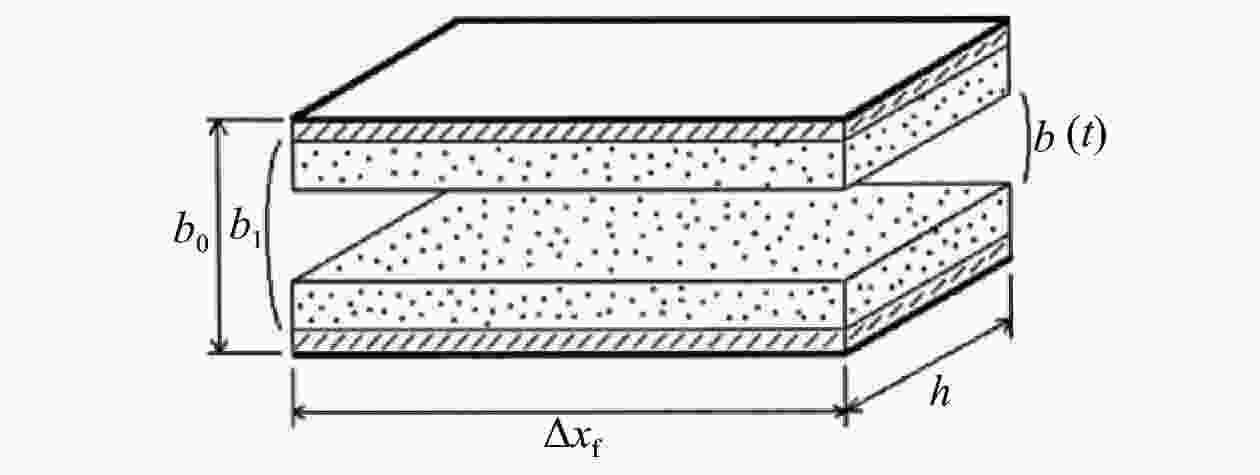
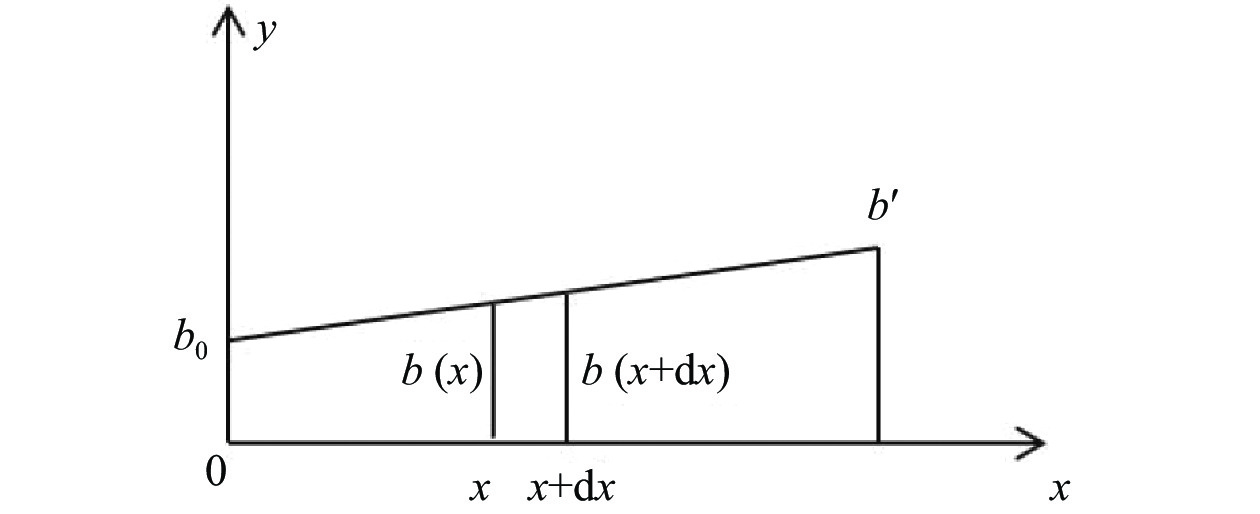
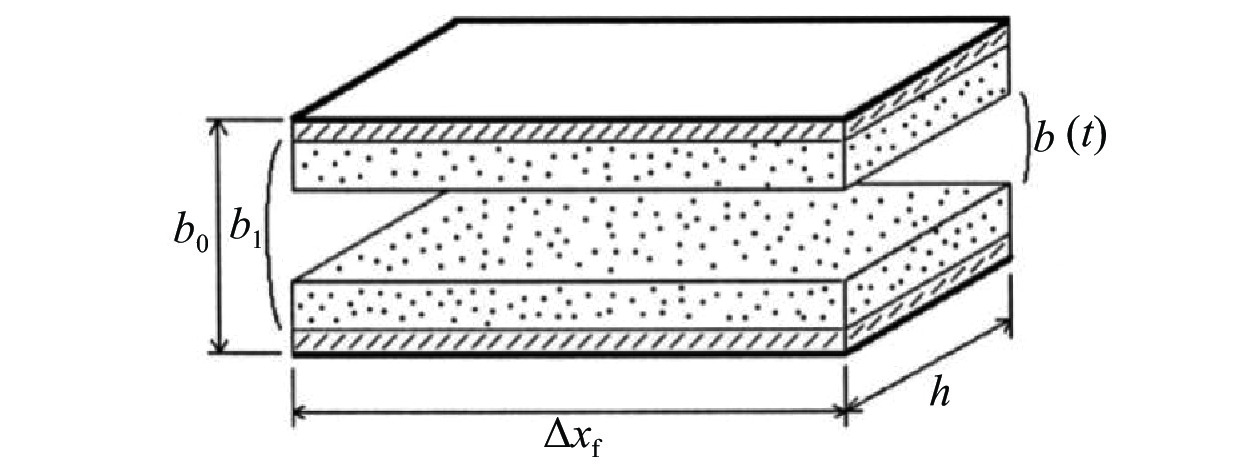
图 4 裂隙中附着的沉淀导致隙宽变化示意图
Figure 4. Schematic diagram of aperture variation caused by attached precipitates in fractures
-
[1] ZHANG B, SHI L, YU X, et al. Assessing the water-sealed safety of an operating underground crude oil storage adjacent to a new similar cavern – a case study in China[J]. Engineering Geology, 2019, 249: 257-272. doi: 10.1016/j.enggeo.2019.01.008 [2] 王章琼, 晏鄂川, 季惠斌, 等. 我国环太平洋西海岸地区地下水封洞库选址区域稳定性研究[J]. 工程地质学报, 2013, 21(4): 626-633. (WANG Z Q, YAN E C, JI H B, et al. Regional stability of underground water sealed storage caverns around western pacific coastal area in China[J]. Journal of Engineering Geology, 2013, 21(4): 626-633. (in Chinese) doi: 10.3969/j.issn.1004-9665.2013.04.021WANG Z Q, YAN E C, JI H B, et al. Regional stability of underground water sealed storage caverns around western pacific coastal area in China[J]. Journal of Engineering Geology, 2013, 21(4): 626-633. (in Chinese) doi: 10.3969/j.issn.1004-9665.2013.04.021 [3] 王者超, 李术才, 梁建毅, 等. 地下水封石油洞库渗水量预测与统计[J]. 岩土工程学报, 2014, 36(8): 1490-1497. (WANG Z C, LI S C, LIANG J Y, et al. Prediction and measurement of groundwater flow rate of underground crude oil storage caverns[J]. Chinese Journal of Geotechnical Engineering, 2014, 36(8): 1490-1497. (in Chinese) doi: 10.11779/CJGE201408015WANG Z C, LI S C, LIANG J Y, et al. Prediction and measurement of groundwater flow rate of underground crude oil storage caverns[J]. Chinese Journal of Geotechnical Engineering, 2014, 36(8): 1490-1497. (in Chinese) doi: 10.11779/CJGE201408015 [4] 张 彬, 霍东平, 彭振华, 等. 基于GIS的中国东部沿海地区地下水封油库建造适宜性研究[J]. 工程地质学报, 2015, 23(4): 801-809. (ZHANG B, HUO D P, PENG Z H, et al. GIS-based approach for construction suitability evaluation of underground water-sealed oil storage caverns in east coast of China[J]. Journal of Engineering Geology, 2015, 23(4): 801-809. (in Chinese)ZHANG B, HUO D P, PENG Z H, et al. GIS-based approach for construction suitability evaluation of underground water-sealed oil storage caverns in east coast of China[J]. Journal of Engineering Geology, 2015, 23(4): 801-809. (in Chinese) [5] BARTON N, QUADROS E. Understanding the need for pre-injection from permeability measurements: what is the connection?[J]. Journal of Rock Mechanics and Geotechnical Engineering, 2019, 11(3): 576-597. doi: 10.1016/j.jrmge.2018.12.008 [6] 刘乾灵, 张 彬, 李玉涛, 等. MICP技术在地下水封油库渗控注浆中的应用潜力[J]. 工程地质学报, 2024, 32(4): 1412-1423. (LIU Q L, ZHANG B, LI Y T, et al. Application potential of MICP in seepage control grouting of underground water-sealed oil storage cavern[J]. Journal of Engineering Geology, 2024, 32(4): 1412-1423. (in Chinese)LIU Q L, ZHANG B, LI Y T, et al. Application potential of MICP in seepage control grouting of underground water-sealed oil storage cavern[J]. Journal of Engineering Geology, 2024, 32(4): 1412-1423. (in Chinese) [7] KIRKLAND C M, THANE A, HIEBERT R, et al. Addressing wellbore integrity and thief zone permeability using microbially-induced calcium carbonate precipitation (MICP): a field demonstration[J]. Journal of Petroleum Science and Engineering, 2020, 190: 107060. doi: 10.1016/j.petrol.2020.107060 [8] BAGAL J, ONADEKO G, HAZEL P, et al. Annular barrier as an alternative to squeezes in challenging wells: technology review and case histories[C]//Proceedings of the Paper presented at the SPE/AAPG Africa Energy and Technology Conference. Nairobi: SPE, 2016. [9] WEIDEBORG M, KÄLLQVIST T, ØDEGÅRD K E, et al. Environmental risk assessment of acrylamide and methylolacrylamide from a grouting agent used in the tunnel construction of Romeriksporten, Norway[J]. Water Research, 2001, 35(11): 2645-2652. doi: 10.1016/S0043-1354(00)00550-9 [10] 白文军. 水封洞库工程预灌浆策略及实施要点[J]. 水利水电技术(中英文), 2022, 53(S2): 200-204. (BAI W J. Pre-excavation grouting strategy and implementation points of water sealed cavern project[J]. Water Resources and Hydropower Engineering, 2022, 53(S2): 200-204. (in Chinese)BAI W J. Pre-excavation grouting strategy and implementation points of water sealed cavern project[J]. Water Resources and Hydropower Engineering, 2022, 53(S2): 200-204. (in Chinese) [11] SHI L, ZHANG B, WANG H X, et al. Investigation on the causes of abnormal increase of water inflow in underground water-sealed storage system[J]. Tunnelling and Underground Space Technology, 2019, 87: 174-186. doi: 10.1016/j.tust.2019.02.013 [12] LI N Y, FENG W T, YU J J, et al. Recent advances in geological storage: trapping mechanisms, storage sites, projects, and application of machine learning[J]. Energy & Fuels, 2023, 37(14): 10087-10111. [13] MOLNÁR Z, PEKKER P, DÓDONY I, et al. Clay minerals affect calcium (magnesium) carbonate precipitation and aging[J]. Earth and Planetary Science Letters, 2021, 567: 116971. doi: 10.1016/j.jpgl.2021.116971 [14] WALL N A, MAULDEN E, GAGER E J, et al. Functionalized clays for radionuclide sequestration: a review[J]. ACS Earth and Space Chemistry, 2022, 6(11): 2552-2574. doi: 10.1021/acsearthspacechem.2c00098 [15] 王敬奎. 注浆堵水在地下水封洞库中的应用[J]. 西部探矿工程, 2020, 32(4): 41-44, 48. (WANG J K. Application of grouting for water blocking in underground water-sealed caverns[J]. West-China Exploration Engineering, 2020, 32(4): 41-44, 48. (in Chinese)WANG J K. Application of grouting for water blocking in underground water-sealed caverns[J]. West-China Exploration Engineering, 2020, 32(4): 41-44, 48. (in Chinese) [16] 欧阳伟雄, 贺宝林. 复合材料注浆在地下水封石油洞库工程中的应用[J]. 油气田地面工程, 2022, 41(9): 106-111. (OUYANG W X, HE B L. Application of composite materials grouting in underground water-sealed oil storage in rock cavern engineering[J]. Oil-Gas Surface Engineering, 2022, 41(9): 106-111. (in Chinese)OUYANG W X, HE B L. Application of composite materials grouting in underground water-sealed oil storage in rock cavern engineering[J]. Oil-Gas Surface Engineering, 2022, 41(9): 106-111. (in Chinese) [17] DE MUYNCK W, DE BELIE N, VERSTRAETE W. Microbial carbonate precipitation in construction materials: a review[J]. Ecological Engineering, 2010, 36(2): 118-136. doi: 10.1016/j.ecoleng.2009.02.006 [18] HE J, CHU J, GAO Y F, et al. Research advances and challenges in biogeotechnologies[J]. Geotechnical Research, 2019, 6(2): 144-155. doi: 10.1680/jgere.18.00035 [19] 刘汉龙, 肖 鹏, 肖 杨, 等. 微生物岩土技术及其应用研究新进展[J]. 土木与环境工程学报(中英文), 2019, 41(1): 1-14. (LIU H L, XIAO P, XIAO Y, et al. State-of-the-art review of biogeotechnology and its engineering applications[J]. Journal of Civil and Environmental Engineering, 2019, 41(1): 1-14. (in Chinese)LIU H L, XIAO P, XIAO Y, et al. State-of-the-art review of biogeotechnology and its engineering applications[J]. Journal of Civil and Environmental Engineering, 2019, 41(1): 1-14. (in Chinese) [20] MINTO J M, MACLACHLAN E, EL MOUNTASSIR G, et al. Rock fracture grouting with microbially induced carbonate precipitation[J]. Water Resources Research, 2016, 52(11): 8827-8844. doi: 10.1002/2016WR018884 [21] SONG CP, ELSWORTH D, JIA Y Z, et al. Permeable rock matrix sealed with microbially-induced calcium carbonate precipitation: evolutions of mechanical behaviors and associated microstructure[J]. Engineering Geology, 2022, 304: 106697. doi: 10.1016/j.enggeo.2022.106697 [22] 孙 哲, 张 彬, 陈大伟, 等. 花岗岩裂隙岩体油水两相渗流可视化试验及数值模拟研究[J]. 地学前缘, 2023, 30(3): 465-475. (SUN Z, ZHANG B, CHEN D W, et al. Two-phase oil/water seepage in fractured granite rock mass: insight from seepage visualization experiment and numerical simulation[J]. Geoscience Frontiers, 2023, 30(3): 465-475. (in Chinese)SUN Z, ZHANG B, CHEN D W, et al. Two-phase oil/water seepage in fractured granite rock mass: insight from seepage visualization experiment and numerical simulation[J]. Geoscience Frontiers, 2023, 30(3): 465-475. (in Chinese) [23] CUTHBERT M O, MCMILLAN L A, HANDLEY-SIDHU S, et al. A field and modeling study of fractured rock permeability reduction using microbially induced calcite precipitation[J]. Environmental Science & Technology, 2013, 47(23): 13637-13643. [24] WU C Z, CHU J, WU S F, et al. Quantifying the permeability reduction of biogrouted rock fracture[J]. Rock Mechanics and Rock Engineering, 2019, 52(3): 947-954. doi: 10.1007/s00603-018-1669-9 [25] WU C Z, CHU J, WU S F, et al. 3D characterization of microbially induced carbonate precipitation in rock fracture and the resulted permeability reduction[J]. Engineering Geology, 2019, 249: 23-30. doi: 10.1016/j.enggeo.2018.12.017 [26] WU C Z, CHU J, WU S F, et al. Microbially induced calcite precipitation along a circular flow channel under a constant flow condition[J]. Acta Geotechnica, 2019, 14(3): 673-683. doi: 10.1007/s11440-018-0747-1 [27] TOBLER D J, MACLACHLAN E, PHOENIX V R. Microbially mediated plugging of porous media and the impact of differing injection strategies[J]. Ecological Engineering, 2012, 42: 270-278. doi: 10.1016/j.ecoleng.2012.02.027 [28] TOBLER D J, MINTO J M, EL MOUNTASSIR G, et al. Microscale analysis of fractured rock sealed with microbially induced CaCO3 precipitation: influence on hydraulic and mechanical performance[J]. Water Resources Research, 2018, 54(10): 8295-8308. doi: 10.1029/2018WR023032 [29] 肖维民, 林 馨, 钟建敏, 等. 岩石节理微生物诱导碳酸钙沉积封堵渗流演化规律试验研究[J]. 岩土力学, 2023, 44(10): 2798-2808. (XIAO W M, LIN X, ZHONG J M, et al. Experimental study on rock joint permeability evolution during plugging process by microbially induced calcite precipitation[J]. Rock and Soil Mechanics, 2023, 44(10): 2798-2808. (in Chinese)XIAO W M, LIN X, ZHONG J M, et al. Experimental study on rock joint permeability evolution during plugging process by microbially induced calcite precipitation[J]. Rock and Soil Mechanics, 2023, 44(10): 2798-2808. (in Chinese) [30] EL MOUNTASSIR G, LUNN R J, MOIR H, et al. Hydrodynamic coupling in microbially mediated fracture mineralization: formation of self-organized groundwater flow channels[J]. Water Resources Research, 2014, 50(1): 1-16. doi: 10.1002/2013WR013578 [31] CARDOSO R, ARBABZADEH E, DE LIMA J T, et al. The influence of stone joints width and roughness on the efficiency of biocementation sealing[J]. Construction and Building Materials, 2021, 283: 122743. doi: 10.1016/j.conbuildmat.2021.122743 [32] ZAMBARE N M, LAUCHNOR E G, GERLACH R. Controlling the distribution of microbially precipitated calcium carbonate in radial flow environments[J]. Environmental Science & Technology, 2019, 53(10): 5916-5925. [33] WHIFFIN V S, VAN PAASSEN L A, HARKES M P. Microbial carbonate precipitation as a soil improvement technique[J]. Geomicrobiology Journal, 2007, 24(5): 417-423. doi: 10.1080/01490450701436505 [34] DEJONG J T, MORTENSEN B M, MARTINEZ B C, et al. Bio-mediated soil improvement[J]. Ecological Engineering, 2010, 36(2): 197-210. doi: 10.1016/j.ecoleng.2008.12.029 [35] WHIFFIN V S. Microbial CaCO3 precipitation for the production of biocement[D]. Perth: Murdoch University, 2004. [36] CHEN Y Q, WANG S Q, TONG X Y, et al. Towards the sustainable fine control of microbially induced calcium carbonate precipitation[J]. Journal of Cleaner Production, 2022, 377: 134395. doi: 10.1016/j.jclepro.2022.134395 [37] IVANOV V, CHU J. Applications of microorganisms to geotechnical engineering for bioclogging and biocementation of soil in situ[J]. Reviews in Environmental Science and Bio/Technology, 2008, 7(2): 139-153. doi: 10.1007/s11157-007-9126-3 [38] 苏 飞. 微生物CaCO3固砂研究: 参数优化及技术改进[D]. 北京: 中国地质大学, 2022. (SU F. Research on microbial CaCO3 sand consolidation: parameter optimization and technological improvements[D]. Beijing: China University of Geosciences, 2022. (in Chinese)SU F. Research on microbial CaCO3 sand consolidation: parameter optimization and technological improvements[D]. Beijing: China University of Geosciences, 2022. (in Chinese) [39] RODEN E E, LEONARDO M R, FERRIS F G. Immobilization of strontium during iron biomineralization coupled to dissimilatory hydrous ferric oxide reduction[J]. Geochimica et Cosmochimica Acta, 2002, 66(16): 2823-2839. doi: 10.1016/S0016-7037(02)00878-5 [40] AL QABANY A, SOGA K, SANTAMARINA C. Factors affecting efficiency of microbially induced calcite precipitation[J]. Journal of Geotechnical and Geoenvironmental Engineering, 2012, 138(8): 992-1001. doi: 10.1061/(ASCE)GT.1943-5606.0000666 [41] HAN C. Modeling for the effect of in-situ bacteria growth on permeability reduction of a fractured medium[J]. Energy Sources, 2003, 25(3): 203-215. doi: 10.1080/00908310390142244 [42] HOMMEL J, LAUCHNOR E, PHILLIPS A, et al. A revised model for microbially induced calcite precipitation: Improvements and new insights based on recent experiments[J]. Water Resources Research, 2015, 51(5): 3695-3715. doi: 10.1002/2014WR016503 [43] WITHERSPOON P A, WANG J S Y, IWAI K, et al. Validity of Cubic Law for fluid flow in a deformable rock fracture[J]. Water Resources Research, 1980, 16(6): 1016-1024. doi: 10.1029/WR016i006p01016 -

 下载:
下载:

图(5)
计量
- 文章访问数: 260
- HTML全文浏览量: 117
- PDF下载量: 17
- 被引次数: 0
