


Comprehensive evaluation of water resources carrying capacity in Chengde area
-
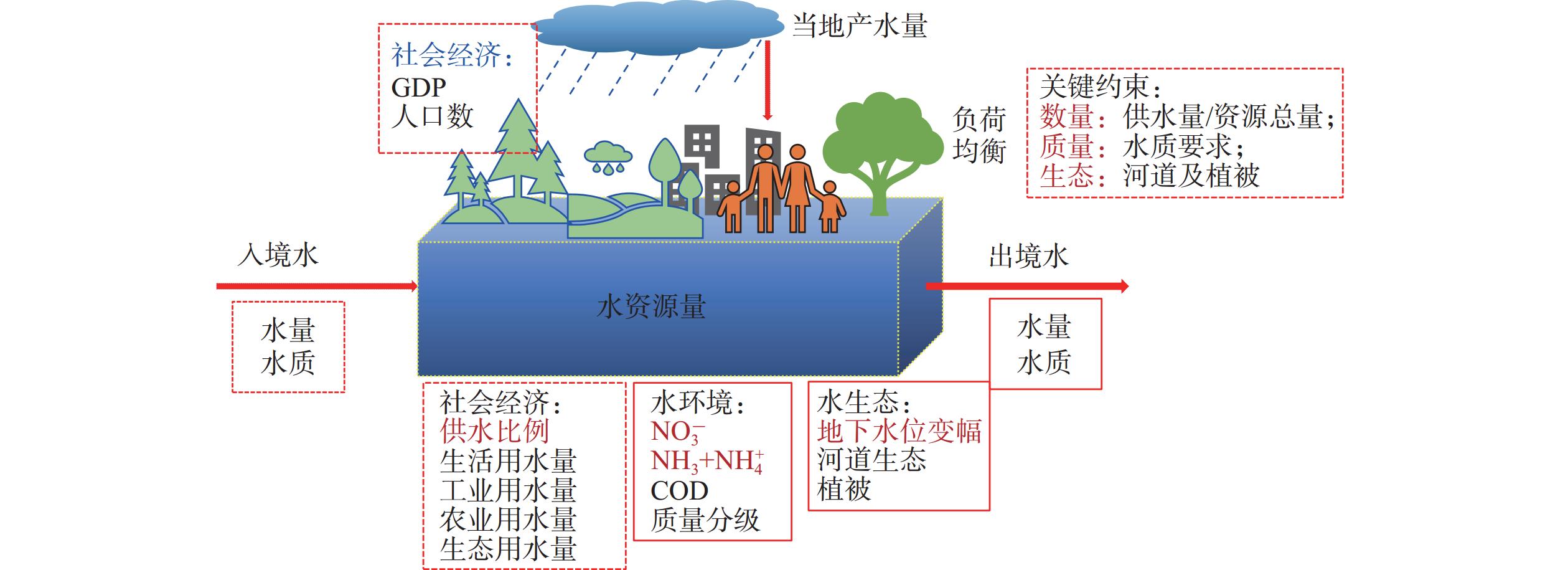
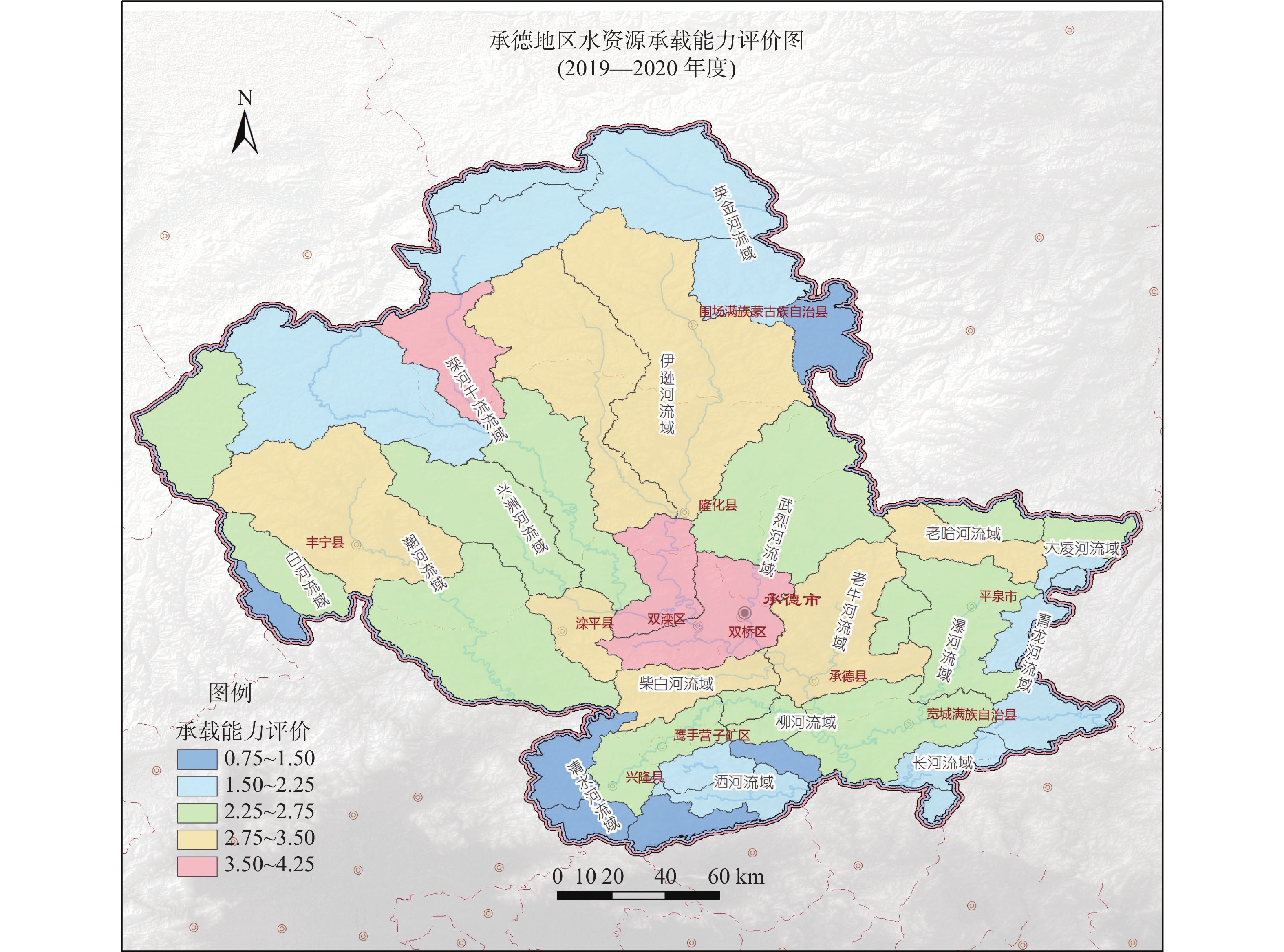
摘要: 承德地区作为京津冀重要的水源涵养区和生态屏障,其水资源承载力对区域可持续发展与生态安全至关重要。本研究基于承德市全域水资源供需关系、质量状况及地下水位动态监测数据,提出以供水比例、氮汇负荷及地下水位变幅为核心的三要素评价模型,结合层次分析法确定指标权重,系统评估了43个小流域的水资源承载力空间分异特征。结果表明:承德市、承德县及隆化县周边流域因农业灌溉用水占比高(62%)、局部氮负荷偏高及地下水开采压力较大(年均降幅>0.5 m)等问题,水资源承载力相对较低;而围场县、丰宁县等北部区域因供水充足、水质稳定且水位波动较小,呈现较高承载力。研究揭示了城镇化进程与农业活动对承载力的复合影响,并建议通过分区管控、监测体系优化及跨区域协同机制提升水资源管理效能。该方法可为中小尺度区域水资源可持续利用提供科学参考。Abstract: As a critical water conservation area and ecological barrier in the Beijing-Tianjin-Hebei region, the water resources carrying capacity (WRCC) of Chengde is vital for regional sustainable development and ecological security. This study proposed a three-factor evaluation model (water supply ratio, nitrogen pollution load, and groundwater level variation) based on monitoring data of water supply-demand relationships, water quality, and groundwater dynamics in Chengde. The analytic hierarchy process (AHP) was applied to determine indicator weights, and the spatial heterogeneity of WRCC across 43 small watersheds was systematically evaluated. Results demonstrate that watersheds around Chengde City, Chengde County, and Longhua County exhibited relatively low WRCC due to high agricultural water use (62%), partial nitrogen load accumulation, and groundwater over-extraction pressure (annual decline >0.5 m). In contrast, northern regions such as Weichang County and Fengning County showed higher WRCC owing to sufficient water supply, stable water quality, and minimal groundwater level fluctuations. The study highlighted the combined effects of urbanization and agricultural practices on WRCC and proposed strategies, including zoning management, monitoring system refinement, and inter-regional coordination to enhance water resource governance. This method provides a scientific foundation for sustainable water resource utilization in medium- and small-scale regions.
-
表 1 供水/水资源总量占比w单项承载能力分级表
标准分级值 供水/水资源总量占比w 单项承载能力分级 1 w<0.25 高 2 0.25≤w<0.5 较高 3 0.5≤w<0.75 中等 4 0.75≤w<1.0 较低 5 w≥1.0 低  下载: 导出CSV
表 2 NH4+/NO3−超标倍数单项承载能力分级表
标准分级值 NH4+/NO3−超标倍数E 单项承载能力分级 1 E<1.0 高 2 1.0≤E<2.5 较高 3 2.5≤E<5.0 中等 4 5.0≤E<10.0 较低 5 E≥10.0 低
下载: 导出CSV
表 3 年际水位变幅单项承载能力分级表
标准分级值 年际水位变幅Δh/m 单项承载能力分级 5 Δh<−0.75 低 4 −0.75≤Δh<−0.3 较低 3 −0.3≤Δh<0 中等 2 0≤Δh<0.5 较高 1 Δh≥0.5 高
下载: 导出CSV
表 4 主要指标的涵义及权重选取
编号 指标 表征内容 属性 指标权重 T1 供水/水资源总量占比/% 社会经济对
水资源的需求− 0.375 T2 地下水位年际升幅/m 地下水供水强度;
满足生态需水+ 0.25 T3 NO3−/氨氮超标倍数 水环境 − 0.375
下载: 导出CSV
表 5 单项承载能力分级及空间计算结果表
序号 次亚系统名称及编号 年内均 丰变均 枯水期变幅 供水占比 供水占比
分级枯水期变
幅(m)分级N
超标倍数N超标
倍数分级承载能力
评价结果1 吐里根河次亚系统(Ⅰ1-2) 0.13 0.02 −0.07 0.38 2 3 0.36 1 1.88 2 阴河次亚系统(Ⅲ1-1) 0.06 0.39 0.67 0.38 2 1 2.14 2 1.75 3 小滦河上游次亚系统(Ⅰ1-3) 0.17 0.52 0.39 0.38 2 2 0.75 1 1.63 4 伊逊河中上游次亚系统(Ⅰ3-2) 0.29 −0.07 −0.25 0.57 3 3 7.44 4 3.38 5 乌力代河次亚系统(Ⅲ1-2) 0.38 2 2 0.10 1 1.63 6 蚁蚂吐河次亚系统(Ⅰ3-1) −0.02 0.06 0.33 0.57 3 2 6.29 4 3.13 7 小滦河下游次亚系统(Ⅰ1-4) 0.35 0.04 −0.37 0.38 2 4 14.95 5 3.63 8 西路噶河次亚系统(Ⅲ1-3) 0.38 2 0 0.10 1 1.13 9 大滦河次亚系统(Ⅰ1-1) 0.41 0.52 0.18 0.47 2 2 0.99 1 1.63 10 闪电河次亚系统(Ⅰ1-6) −0.28 1.51 0.02 0.47 2 2 4.23 3 2.38 11 滦河上游次亚系统(Ⅰ1-5) 0.20 −0.08 0.13 0.77 4 2 0.00 1 2.38 12 武烈河上游次亚系统(Ⅰ4-1) 0.46 0.38 0.14 0.62 3 2 1.87 2 2.38 13 潮河上游次亚系统(Ⅱ1-1) 0.76 0.7 0.11 0.47 2 2 11.65 5 3.13 14 兴洲河上游次亚系统(Ⅰ2-1) 0.42 0.54 0.45 0.47 2 2 2.75 3 2.38 15 老哈河下游次亚系统(Ⅲ2-2) −0.17 −0.77 −0.19 0.61 3 3 1.33 2 2.63 16 老哈河上游次亚系统(Ⅲ2-1) 0.13 −0.33 −0.003 0.61 3 3 3.58 3 3.00 17 汤河次亚系统(Ⅱ2-1) 0.41 −0.4 −0.9 0.47 2 5 0.49 1 2.38 18 伊逊河下游次亚系统(Ⅰ3-3) 0.13 −0.08 0.16 0.77 4 2 17.32 5 3.88 19 榆树林子次亚系统(Ⅳ1-1) 0.61 3 4 2.95 3 2.25 20 下板城次亚系统(Ⅰ6-2) 0.21 −0.08 0.01 0.48 2 2 57.26 5 3.13 21 潮河下游次亚系统(Ⅱ1-2) 0.94 0.53 0.07 0.63 3 2 2.52 3 2.75 22 大鹿沟次亚系统(Ⅳ1-2) 0.61 3 3 0.10 1 1.50 23 瀑河上游次亚系统(Ⅰ8-1) 0.44 −0.02 0.13 0.61 3 2 3.95 3 2.75 24 武烈河下游次亚系统(Ⅰ4-2) 0.20 0.39 0.29 1.36 5 2 13.41 5 4.25 25 天河次亚系统(Ⅱ2-2) 0.47 2 2 0.10 1 1.13 26 青龙河上游次亚系统(Ⅰ11-1) 0.61 3 2 0.10 1 1.50 27 六沟次亚系统(Ⅰ6-1) 0.35 −0.22 −0.12 0.61 3 3 0.10 1 2.25 28 兴洲河下游次亚系统(Ⅰ2-2) 0.69 0.67 0.68 0.78 4 1 4.53 3 2.88 29 青龙河上游次亚系统(Ⅰ11-1)1 0.61 3 2 0.10 1 1.50 30 柴白河次亚系统(Ⅰ5-1) 0.67 0.22 −1.06 0.48 2 5 7.24 4 3.50 31 瀑河下游次亚系统(Ⅰ8-2) 0.74 0.42 0.16 0.55 3 2 4.92 3 2.75 32 青龙河中游次亚系统(Ⅰ11-2) 0.55 3 2 0.10 1 1.50 33 瀑河下游次亚系统(Ⅰ8-2)1 −2.36 −0.8 0.17 0.48 2 2 4.00 3 2.38 34 车河次亚系统(Ⅰ7-2) 0.43 0.21 0.03 0.13 1 2 8.15 4 2.38 35 兴隆次亚系统(Ⅰ7-1) 0.46 −0.03 −0.22 0.13 1 3 3.28 3 2.25 36 清水河次亚系统(Ⅱ3-1) 0.55 0.28 0.28 0.13 1 2 0.10 1 1.25 37 长河次亚系统(Ⅰ10-1) 1.09 0.88 0.13 0.55 3 2 0.10 1 2.00 38 横河次亚系统(Ⅰ9-1) 0.78 0.28 −0.15 0.13 1 3 1.55 2 1.88 39 二道沟次亚系统(Ⅰ9-3) 0.13 1 1 0.90 1 0.75 40 南天门次亚系统(Ⅰ9-2) 1.59 1.01 −0.12 0.13 1 3 0.87 1 1.50 41 铧尖次亚系统(Ⅰ10-2) 0.55 3 1 0.50 1 1.50 42 沙河次亚系统(Ⅱ3-3) 0.13 1 1 1.96 2 1.13 43 泃河次亚系统(Ⅱ3-2) 0.13 1 1 1.79 2 1.13 注:“N超标倍数”为“NH4+/NO3−超标倍数”简称;“N超标倍数分级”为“NH4+/NO3−超标倍数分级”简称。
下载: 导出CSV
-
[1] 王 玫, 王立源. 京津冀水源生态涵养区建设面临的困境及应对措施[J]. 环境保护, 2015, 43(16): 40-43. (WANG M, WANG L Y. Difficulties and measures in the construction of water ecological conservation areas in Beijing, Tianjin and Hebei[J]. Environmental Protection, 2015, 43(16): 40-43. (in Chinese)WANG M, WANG L Y. Difficulties and measures in the construction of water ecological conservation areas in Beijing, Tianjin and Hebei[J]. Environmental Protection, 2015, 43(16): 40-43. (in Chinese) [2] 李 冲, 张 璇, 吴一帆, 等. 京津冀生态屏障区景观格局变化及其对水源涵养的影响[J]. 中国环境科学, 2019, 39(6): 2588-2595. (LI C, ZHANG X, WU Y F, et al. Landscape pattern change of the ecological barrier zone in Beijing-Tianjin-Hebei region and its impact on water conservation[J]. China Environmental Science, 2019, 39(6): 2588-2595. (in Chinese) doi: 10.3969/j.issn.1000-6923.2019.06.042LI C, ZHANG X, WU Y F, et al. Landscape pattern change of the ecological barrier zone in Beijing-Tianjin-Hebei region and its impact on water conservation[J]. China Environmental Science, 2019, 39(6): 2588-2595. (in Chinese) doi: 10.3969/j.issn.1000-6923.2019.06.042 [3] 封志明, 刘登伟. 京津冀地区水资源供需平衡及其水资源承载力[J]. 自然资源学报, 2006, 21(5): 689-699. (FENG Z M, LIU D W. A study on water resources carrying capacity in Jingjinji region[J]. Journal of Natural Resources, 2006, 21(5): 689-699. (in Chinese) doi: 10.3321/j.issn:1000-3037.2006.05.002FENG Z M, LIU D W. A study on water resources carrying capacity in Jingjinji region[J]. Journal of Natural Resources, 2006, 21(5): 689-699. (in Chinese) doi: 10.3321/j.issn:1000-3037.2006.05.002 [4] 鲁重生, 刘文波, 李志明, 等. 京津冀水源涵养区水化学环境分析——以承德市兴隆县为例[J]. 水文地质工程地质, 2020, 47(6): 132-141. (LU C S, LIU W B, LI Z M, et al. Hydrochemical environment in a typical conservation area in the Beijing-Tianjin-Hebei region: a case study in Xinglong County of Chengde[J]. Hydrogeology & Engineering Geology, 2020, 47(6): 132-141. (in Chinese)LU C S, LIU W B, LI Z M, et al. Hydrochemical environment in a typical conservation area in the Beijing-Tianjin-Hebei region: a case study in Xinglong County of Chengde[J]. Hydrogeology & Engineering Geology, 2020, 47(6): 132-141. (in Chinese) [5] 赵玉峰, 罗专溪, 于亚军, 等. 京津冀西北典型区域地下水位时空演变及驱动因素[J]. 自然资源学报, 2020, 35(6): 1301-1313. (ZHAO Y F, LUO Z X, YU Y J, et al. Spatio-temporal changes of groundwater level and its driving factors in a typical region of Beijing-Tianjin-Hebei region, China[J]. Journal of Natural Resources, 2020, 35(6): 1301-1313. (in Chinese) doi: 10.31497/zrzyxb.20200604ZHAO Y F, LUO Z X, YU Y J, et al. Spatio-temporal changes of groundwater level and its driving factors in a typical region of Beijing-Tianjin-Hebei region, China[J]. Journal of Natural Resources, 2020, 35(6): 1301-1313. (in Chinese) doi: 10.31497/zrzyxb.20200604 [6] 石先闯, 江 男, 安如海, 等. 京津冀水源涵养区承德接坝地区水土保持助推京津冀生态屏障的成效及经验[J]. 吉林水利, 2020(2): 39-41,52. (SHI X C, JIANG N, AN R H, et al. Better effects and experiences in ecological protection for Beijing, Tianjin and Hebei by means of water and soil conservation[J]. Jilin Water Resources, 2020(2): 39-41,52. (in Chinese) doi: 10.3969/j.issn.1009-2846.2020.02.011SHI X C, JIANG N, AN R H, et al. Better effects and experiences in ecological protection for Beijing, Tianjin and Hebei by means of water and soil conservation[J]. Jilin Water Resources, 2020(2): 39-41,52. (in Chinese) doi: 10.3969/j.issn.1009-2846.2020.02.011 [7] 杜海娥, 李 正, 郑 煜. 资源环境承载能力评价和国土空间开发适宜性评价研究进展[J]. 中国矿业, 2019, 28(S2): 159-165. (DU H E, LI Z, ZHENG Y. Research progress on assessment of resources and environment bearing capacity and suitability of land space development[J]. China Mining Magazine, 2019, 28(S2): 159-165. (in Chinese) doi: 10.12075/j.issn.1004-4051.2019.S2.118DU H E, LI Z, ZHENG Y. Research progress on assessment of resources and environment bearing capacity and suitability of land space development[J]. China Mining Magazine, 2019, 28(S2): 159-165. (in Chinese) doi: 10.12075/j.issn.1004-4051.2019.S2.118 [8] 刘佳骏, 董锁成, 李泽红. 中国水资源承载力综合评价研究[J]. 自然资源学报, 2011, 26(2): 258-269. (LIU J J, DONG S C, LI Z H. Comprehensive evaluation of China's water resources carrying capacity[J]. Journal of Natural Resources, 2011, 26(2): 258-269. (in Chinese) doi: 10.11849/zrzyxb.2011.02.009LIU J J, DONG S C, LI Z H. Comprehensive evaluation of China's water resources carrying capacity[J]. Journal of Natural Resources, 2011, 26(2): 258-269. (in Chinese) doi: 10.11849/zrzyxb.2011.02.009 [9] 潘兴瑶, 夏 军, 李法虎, 等. 基于GIS的北方典型区水资源承载力研究——以北京市通州区为例[J]. 自然资源学报, 2007, 22(4): 664-671. (PAN X Y, XIA J, LI F H, et al. Applied study on evaluation method for water resources carrying capacity based on GIS techniques in typical north district[J]. Journal of Natural Resources, 2007, 22(4): 664-671. (in Chinese) doi: 10.3321/j.issn:1000-3037.2007.04.019PAN X Y, XIA J, LI F H, et al. Applied study on evaluation method for water resources carrying capacity based on GIS techniques in typical north district[J]. Journal of Natural Resources, 2007, 22(4): 664-671. (in Chinese) doi: 10.3321/j.issn:1000-3037.2007.04.019 [10] 封志明, 杨艳昭, 闫慧敏, 等. 百年来的资源环境承载力研究: 从理论到实践[J]. 资源科学, 2017, 39(3): 379-395. (FENG Z M, YANG Y Z, YAN H M, et al. A review of resources and environment carrying capacity research since the 20th century: from theory to practice[J]. Resources Science, 2017, 39(3): 379-395. (in Chinese)FENG Z M, YANG Y Z, YAN H M, et al. A review of resources and environment carrying capacity research since the 20th century: from theory to practice[J]. Resources Science, 2017, 39(3): 379-395. (in Chinese) [11] 惠泱河, 蒋晓辉, 黄 强, 等. 水资源承载力评价指标体系研究[J]. 水土保持通报, 2001, 21(1): 30-34. (HUI Y H, JIANG X H, HUANG Q, et al. Research on evaluation index system of water resources bearing capacity[J]. Bulletin of Soil and Water Conservation, 2001, 21(1): 30-34. (in Chinese) doi: 10.3969/j.issn.1000-288X.2001.01.008HUI Y H, JIANG X H, HUANG Q, et al. Research on evaluation index system of water resources bearing capacity[J]. Bulletin of Soil and Water Conservation, 2001, 21(1): 30-34. (in Chinese) doi: 10.3969/j.issn.1000-288X.2001.01.008 [12] 陈楷根. 区域环境承载力理论及其应用[D]. 福州: 福建师范大学, 2002. (CHEN K G. Theory of regional environmental carrying capacity and its application[D]. Fuzhou: Fujian Normal University, 2002. (in Chinese)CHEN K G. Theory of regional environmental carrying capacity and its application[D]. Fuzhou: Fujian Normal University, 2002. (in Chinese) [13] 段新光, 栾芳芳. 基于模糊综合评判的新疆水资源承载力评价[J]. 中国人口·资源与环境, 2014, 24(S1): 119-122. (DUAN X G, LUAN F F. Evaluation of water resources carrying capacity in Xinjiang based on fuzzy comprehensive model[J]. China Population, Resources and Environment, 2014, 24(S1): 119-122. (in Chinese)DUAN X G, LUAN F F. Evaluation of water resources carrying capacity in Xinjiang based on fuzzy comprehensive model[J]. China Population, Resources and Environment, 2014, 24(S1): 119-122. (in Chinese) [14] 朱一中, 夏 军, 谈 戈. 西北地区水资源承载力分析预测与评价[J]. 资源科学, 2003, 25(4): 43-48. (ZHU Y Z, XIA J, TAN G. Measurement and evaluation of water resources carrying capacity of Northwest China[J]. Resources Science, 2003, 25(4): 43-48. (in Chinese) doi: 10.3321/j.issn:1007-7588.2003.04.008ZHU Y Z, XIA J, TAN G. Measurement and evaluation of water resources carrying capacity of Northwest China[J]. Resources Science, 2003, 25(4): 43-48. (in Chinese) doi: 10.3321/j.issn:1007-7588.2003.04.008 [15] 夏 军, 朱一中. 水资源安全的度量: 水资源承载力的研究与挑战[J]. 自然资源学报, 2002, 17(3): 262-269. (XIA J, ZHU Y Z. The measurement of water resources security: a study and challenge on water resources carrying capacity[J]. Journal of Natural Resources, 2002, 17(3): 262-269. (in Chinese) doi: 10.3321/j.issn:1000-3037.2002.03.002XIA J, ZHU Y Z. The measurement of water resources security: a study and challenge on water resources carrying capacity[J]. Journal of Natural Resources, 2002, 17(3): 262-269. (in Chinese) doi: 10.3321/j.issn:1000-3037.2002.03.002 [16] 段春青, 刘昌明, 陈晓楠, 等. 区域水资源承载力概念及研究方法的探讨[J]. 地理学报, 2010, 65(1): 82-90. (DUAN C Q, LIU C M, CHEN X N, et al. Preliminary research on regional water resources carrying capacity conception and method[J]. Acta Geographica Sinica, 2010, 65(1): 82-90. (in Chinese) doi: 10.11821/xb201001009DUAN C Q, LIU C M, CHEN X N, et al. Preliminary research on regional water resources carrying capacity conception and method[J]. Acta Geographica Sinica, 2010, 65(1): 82-90. (in Chinese) doi: 10.11821/xb201001009 [17] 王建华, 翟正丽, 桑学锋, 等. 水资源承载力指标体系及评判准则研究[J]. 水利学报, 2017, 48(9): 1023-1029. (WANG J H, ZHAI Z L, SANG X F, et al. Study on index system and judgment criterion of water resources carrying capacity[J]. Journal of Hydraulic Engineering, 2017, 48(9): 1023-1029. (in Chinese)WANG J H, ZHAI Z L, SANG X F, et al. Study on index system and judgment criterion of water resources carrying capacity[J]. Journal of Hydraulic Engineering, 2017, 48(9): 1023-1029. (in Chinese) -



图(4) / 表(5)
计量
- 文章访问数: 267
- HTML全文浏览量: 94
- PDF下载量: 11
- 被引次数: 0
