


Current status and adaptability research of intelligent robots in complex tunnel construction environments
-
摘要: 隧道施工环境极为复杂,传统的人工及机械施工方式效率低、主观性强,智能机器人凭借其先进的感知、决策和执行能力,极大提高了复杂环境下隧道工程的施工精度和可靠性。为了研究智能机器人对复杂隧道施工环境的适应性,在总结国内外应用现状的基础上,对复杂隧道施工环境特点进行了详细分析,明确了地质条件复杂、空间受限以及环境恶劣等因素对智能机器人作业的影响。从工程案例出发,展示了智能机器人在提高隧道施工效率、提升质量和保障安全等方面的优势,探究了导航与定位精度、通信稳定性、能源供应与续航能力等影响智能机器人适应性的技术影响因素,以及施工工艺匹配度和与其他设备协同作业能力等工程影响因素,提出包括定制化设计和加强设备间协同作业标准化等策略,确保智能机器人能够更好地适应复杂隧道施工环境和工艺要求,提高隧道施工效率和安全性。Abstract: The tunnel construction environment exhibits extreme complexity and traditional manual and mechanical construction methods have low efficiency and strong subjectivity. With their advanced perception, decision-making, and execution capabilities, intelligent robots have significantly enhanced the precision and reliability of tunnel engineering construction in complex environments. This study systematically analyzes the distinctive characteristics of tunnel construction environments. On the basis of summarizing the current research status at home and abroad, it identifies three predominant factors - complex geological conditions, spatial constraints, and harsh working environments - that significantly impact the operational performance of intelligent robots. Starting from engineering cases, it demonstrates the advantages of intelligent robots in improving tunnel construction efficiency, quality, and safety. At the same time, the technical factors affecting the adaptability of intelligent robots, such as navigation and positioning accuracy, communication stability, energy supply and endurance, as well as engineering factors such as construction process matching and collaborative operation ability with other equipment, were explored. Finally, a series of practical and feasible strategies were proposed, including customized design and strengthening the standardization of collaborative operation between equipment, to ensure that intelligent robots can better adapt to complex tunnel construction environments and process requirements, and improve tunnel construction efficiency and safety.
-
Key words:
- tunnel /
- intelligent robot /
- current applications /
- influencing factors /
- adaptability
-
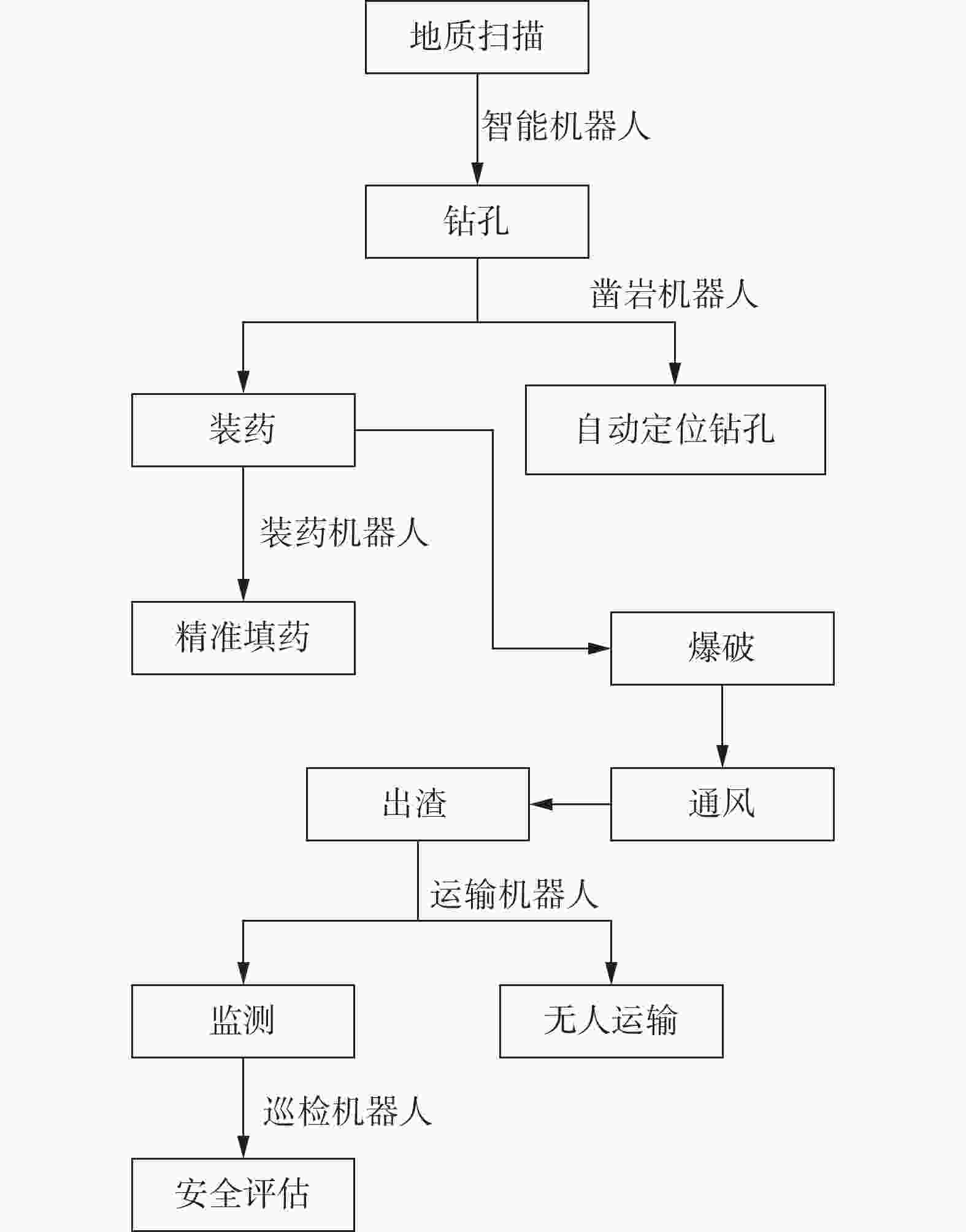
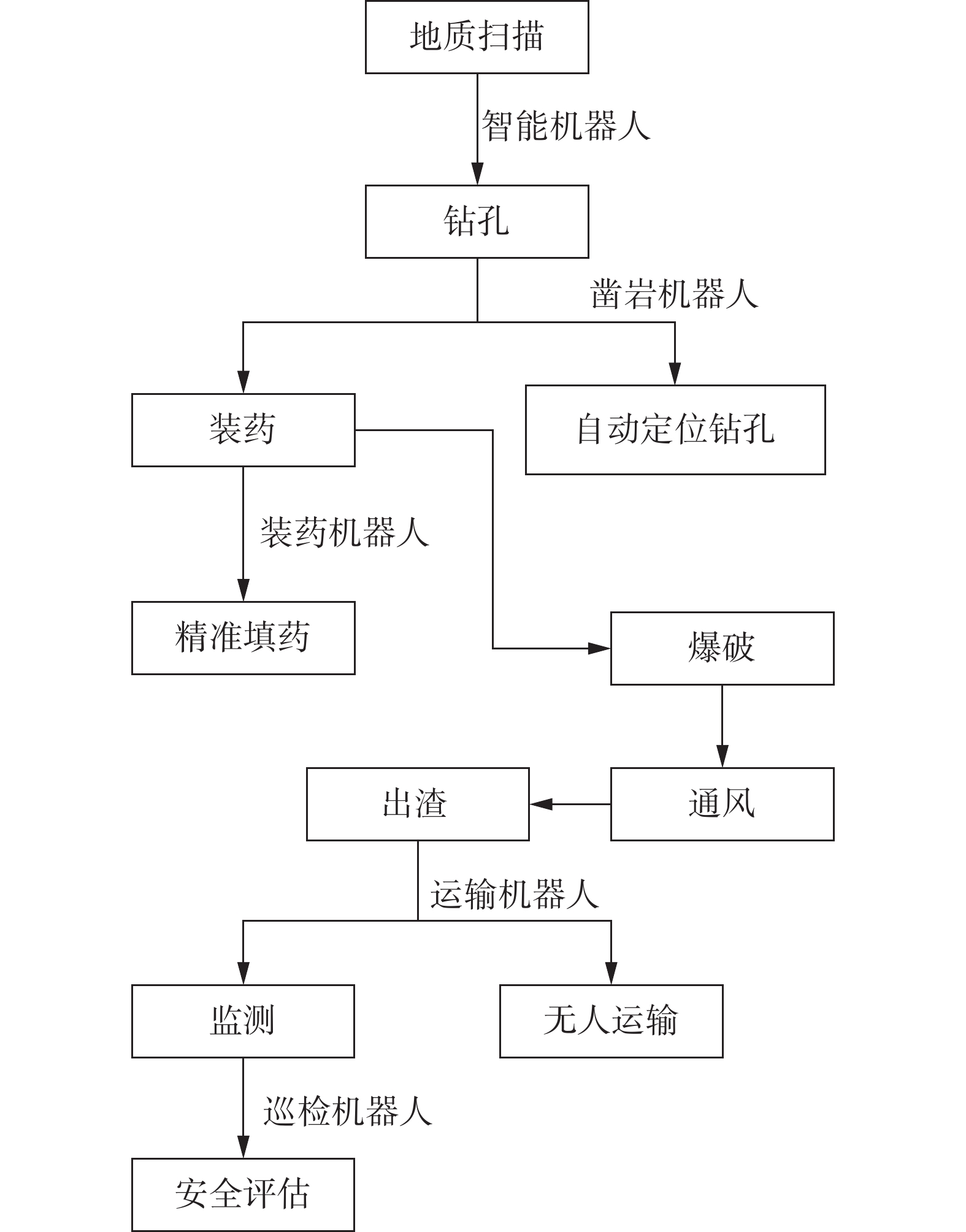
图 6 钻爆法施工与智能机器人配合流程图
Figure 6. Flowchart of drilling and blasting construction coordinated with intelligent robots
表 1 凿岩机器人前后施工效率
Table 1. Construction efficiency before and after using rock-drilling robots
对比项目 每个循环进尺/m 钻孔精度/mm 施工人员数量/人 人工凿岩 1.6 ±50 8 凿岩机器人 4 ±15 2 变化情况 提高150% 精度提高 700% 减少75%  下载: 导出CSV
表 2 湿喷机和拱架机器人前后施工质量对比
Table 2. Comparison of construction quality before and after using the wet shotcreting machine and the arch robot
对比项目 湿喷每小时
喷射量/m3湿喷回
弹率/%每榀拱架安装
时间/min每榀拱架安装
施工人员数量人工作业 10 25 60 9 机器人作业 30 10 20 3 变化情况 提高200% 降低60% 缩短66% 减少66%
下载: 导出CSV
表 3 智能机器人与其他设备协同作业标准和规范
Table 3. Standards and specifications for collaborative operation between intelligent robots and other equipment
协同作业环节 通信要求 作业顺序 安全注意事项 隧道开挖 采用工业以太网通信,挖掘机器人实时向装载机和运输车辆发送挖掘进度和位置信息,装载机和运输车辆及时反馈自身状态信息 挖掘机器人先进行挖掘,达到一定量后,装载机进行装载,运输车辆等待装载,装载完成后运输车辆运出岩石 挖掘机器人作业时,周围严禁其他人员和设备靠近;装载机和运输车辆行驶过程中,保持安全距离,遵守交通规则 初期支护 通过 OPC UA 协议实现湿喷机器人、拱架机器人与其他支护设备的数据交互,实时调整作业参数 先进行拱架安装,拱架安装完成后,湿喷机器人进行喷射混凝土作业 湿喷机器人喷射作业时,确保喷头方向正确,避免混凝土飞溅伤人;拱架机器人作业时,注意防止拱架掉落 隧道检测 建立专用的无线通信网络,检测机器人与控制中心实时通信,上传检测数据 检测机器人按照预定路线进行检测,检测完成后将数据传输给控制中心进行分析处理 检测机器人在隧道内行驶时,设置警示标志,防止其他设备碰撞;控制中心及时对检测数据进行分析,发现问题及时通知相关人员处理
下载: 导出CSV
-
[1] 巩江峰, 王 伟, 黎 旭, 等. 截至2024年底中国铁路隧道情况统计及2024年新开通项目隧道情况介绍[J]. 隧道建设(中英文), 2025, 45(3): 636-653. (GONG J F, WANG W, LI X, et al. Statistics of China’s railway tunnels by the end of 2024 and overview of tunnels of new projects in 2024[J]. Tunnel Construction, 2025, 45(3): 636-653. (in Chinese) doi: 10.3973/j.issn.2096-4498.2025.03.019GONG J F, WANG W, LI X, et al. Statistics of China’s railway tunnels by the end of 2024 and overview of tunnels of new projects in 2024[J]. Tunnel Construction, 2025, 45(3): 636-653. (in Chinese) doi: 10.3973/j.issn.2096-4498.2025.03.019 [2] 甘淇匀, 周 建. 国内外隧道监控量测技术发展现状综述[J]. 地下空间与工程学报, 2019, 15(S1): 400-415. (GAN Q Y, ZHOU J. Current research on tunnel monitoring and measurement technology[J]. Chinese Journal of Underground Space and Engineering, 2019, 15(S1): 400-415. (in Chinese)GAN Q Y, ZHOU J. Current research on tunnel monitoring and measurement technology[J]. Chinese Journal of Underground Space and Engineering, 2019, 15(S1): 400-415. (in Chinese) [3] HAUSWIRTH D, PUZRIN A M, CARRERA A, et al. Use of fibre-optic sensors for simple assessment of ground surface displacements during tunnelling[J]. Géotechnique, 2014, 64(10): 837-842. doi: 10.1680/geot.14.t.009 [4] BURSI O S, TONDINI N, FASSIN M, et al. Structural monitoring for the cyclic behaviour of concrete tunnel lining sections using FBG sensors[J]. Structural Control and Health Monitoring, 2016, 23(4): 749-763. doi: 10.1002/stc.1807 [5] MOFFAT R, SOTOMAYOR J, BELTRÁN J F. Estimating tunnel wall displacements using a simple sensor based on a Brillouin optical time domain reflectometer apparatus[J]. International Journal of Rock Mechanics and Mining Sciences, 2015, 75: 233-243. doi: 10.1016/j.ijrmms.2014.10.013 [6] QIN C S, MA C Y, LI L P, et al. Development and application of an intelligent robot for rock mass structure detection: a case study of Letuan tunnel in Shandong, China[J]. International Journal of Rock Mechanics and Mining Sciences, 2023, 169: 105419, doi: 10.1016/j.ijrmms.2023.105419 [7] 郭卫社, 洪开荣, 高 攀, 等. 我国隧道智能建造技术发展与展望[J]. 隧道建设(中英文), 2023, 43(4): 549-562. (GUO W S, HONG K R, GAO P, et al. Status quo and prospects of tunnel intelligent construction in China[J]. Tunnel Construction, 2023, 43(4): 549-562. (in Chinese) doi: 10.3973/j.issn.2096-4498.2023.04.002GUO W S, HONG K R, GAO P, et al. Status quo and prospects of tunnel intelligent construction in China[J]. Tunnel Construction, 2023, 43(4): 549-562. (in Chinese) doi: 10.3973/j.issn.2096-4498.2023.04.002 [8] 田四明, 吴克非, 王志伟, 等. 中国铁路隧道智能化建造实现路径探讨[J]. 铁道学报, 2022, 44(1): 134-142. (TIAN S M, WU K F, WANG Z W, et al. Development status and implementation path analysis on intelligent construction of mountain tunnels in China[J]. Journal of the China Railway Society, 2022, 44(1): 134-142. (in Chinese)TIAN S M, WU K F, WANG Z W, et al. Development status and implementation path analysis on intelligent construction of mountain tunnels in China[J]. Journal of the China Railway Society, 2022, 44(1): 134-142. (in Chinese) [9] ZHANG Q L, ZHU Y W, MA R, et al. Intelligent tunnelling robot system for deep-buried long tunnels[J]. Frontiers in Earth Science, 2023, 11: 1135948. doi: 10.3389/feart.2023.1135948 [10] 徐剑安, 贾连辉, 荆留杰, 等. 喷浆机器人自适应喷涂路径规划研究[J]. 隧道建设(中英文), 2022, 42(11): 1963-1971. (Xu Jian’an, Jia Lianhui, Jing Liujie, et al. Adaptive spray path planning of shotcrete robot[J]. Tunnel Construction, 2022, 42(11): 1963-1971. (in Chinese)Xu Jian’an, Jia Lianhui, Jing Liujie, et al. Adaptive spray path planning of shotcrete robot[J]. Tunnel Construction, 2022, 42(11): 1963-1971. (in Chinese) [11] 毋焱磊, 陈鑫鑫, 石安政, 等. 锚杆台车工作臂设计及作业空间分析与验证[J]. 机电工程技术, 2023, 52(4): 275-280,308. (WU Y L, CHEN X X, SHI A Z, et al. Working arm design and working space analysis and verification of tunnel anchor rig[J]. Mechanical & Electrical Engineering Technology, 2023, 52(4): 275-280,308. (in Chinese)WU Y L, CHEN X X, SHI A Z, et al. Working arm design and working space analysis and verification of tunnel anchor rig[J]. Mechanical & Electrical Engineering Technology, 2023, 52(4): 275-280,308. (in Chinese) [12] 陈孔福, 申玉生, 赵何霖, 等. 基于破碎带围岩变形受力特征的偏压隧道控制措施研究[J]. 工程地质学报, 2025, 33(2): 621-631. (CHEN K F, SHEN Y S, ZHAO H L, et al. Study on control measures in bias tunnel based on deformation and mechanics characteristics of surrounding rock in fracture zone[J]. Journal of Engineering Geology, 2025, 33(2): 621-631. (in Chinese)CHEN K F, SHEN Y S, ZHAO H L, et al. Study on control measures in bias tunnel based on deformation and mechanics characteristics of surrounding rock in fracture zone[J]. Journal of Engineering Geology, 2025, 33(2): 621-631. (in Chinese) [13] 陈湘生, 全昭熹, 陈一凡, 等. 极端环境隧道建造面临的主要问题及发展趋势[J]. 隧道建设(中英文), 2024, 44(3): 401-432. (CHEN X S, QUAN Z X, CHEN Y F, et al. Primary challenges and developmental trends of tunnel construction in extreme environments[J]. Tunnel Construction, 2024, 44(3): 401-432. (in Chinese) doi: 10.3973/j.issn.2096-4498.2024.03.001CHEN X S, QUAN Z X, CHEN Y F, et al. Primary challenges and developmental trends of tunnel construction in extreme environments[J]. Tunnel Construction, 2024, 44(3): 401-432. (in Chinese) doi: 10.3973/j.issn.2096-4498.2024.03.001 [14] 许振浩, 邵瑞琦, 林 鹏, 等. 隧道不良地质识别: 方法、现状及智能化发展方向[J]. 地球学报, 2024, 45(1): 5-24. (XU Z H, SHAO R Q, LIN P, et al. Adverse geology identification in tunnel: method, research status and intelligent development direction[J]. Acta Geoscientica Sinica, 2024, 45(1): 5-24. (in Chinese) doi: 10.3975/cagsb.2023.030702XU Z H, SHAO R Q, LIN P, et al. Adverse geology identification in tunnel: method, research status and intelligent development direction[J]. Acta Geoscientica Sinica, 2024, 45(1): 5-24. (in Chinese) doi: 10.3975/cagsb.2023.030702 [15] 谷柏森. 隧道高地温应对措施及通风设计——高黎贡山铁路特长隧道可行性研究[J]. 现代隧道技术, 2007, 44(2): 66-71. (GU B S. Countermeasures against high temperatures in a tunnel and the corresponding ventilation design——feasibility study for the super- long Gaoligonshan tunnel[J]. Modern Tunnelling Technology, 2007, 44(2): 66-71. (in Chinese)GU B S. Countermeasures against high temperatures in a tunnel and the corresponding ventilation design——feasibility study for the super- long Gaoligonshan tunnel[J]. Modern Tunnelling Technology, 2007, 44(2): 66-71. (in Chinese) [16] 赵玉报, 陈寿根, 谭信荣. 长大隧道施工中干式除尘机理及应用[J]. 现代隧道技术, 2014, 51(3): 200-205. (ZHAO Y B, CHEN S G, TAN X R. The mechanism and application of dry dust removal technology in long tunnel construction[J]. Modern Tunnelling Technology, 2014, 51(3): 200-205. (in Chinese)ZHAO Y B, CHEN S G, TAN X R. The mechanism and application of dry dust removal technology in long tunnel construction[J]. Modern Tunnelling Technology, 2014, 51(3): 200-205. (in Chinese) [17] 张吉禄, 刘新荣, 周小涵, 等. 川西藏东地区隧道围岩有害气体孕育机制及逸出风险评价研究[J]. 隧道建设(中英文), 2024, 44(2): 296-307. (ZHANG J L, LIU X R, ZHOU X H, et al. Formation mechanism and releasing risk assessment of hazardous gas in tunnel surrounding rocks in western Sichuan and eastern Xizang, China[J]. Tunnel Construction, 2024, 44(2): 296-307. (in Chinese) doi: 10.3973/j.issn.2096-4498.2024.02.009ZHANG J L, LIU X R, ZHOU X H, et al. Formation mechanism and releasing risk assessment of hazardous gas in tunnel surrounding rocks in western Sichuan and eastern Xizang, China[J]. Tunnel Construction, 2024, 44(2): 296-307. (in Chinese) doi: 10.3973/j.issn.2096-4498.2024.02.009 -


计量
- 文章访问数: 46
- HTML全文浏览量: 20
- PDF下载量: 7
- 被引次数: 0
